Quote
x
Enquire
How anilox quality drives flexo print excellence and ROI
Ноябрь 2025Across Europe, we are seeing flexo printers working under increasing pressure. Regulatory demands, higher material and energy costs, supply chain uncertainty and the push for greater automation all influence daily production. At the same time, brand owners expect sharper detail, finer screens, tighter tolerances, and reliable repeatability. Shorter runs and faster changeovers only add to these demands.
In this environment, the anilox remains central to print stability. Yet many of the issues we support customers with are avoidable. Distorted sleeve bases, peeling or separating layers, and anilox affected by corrosion after cleaning or refurbishment, continue to affect print quality. Each disrupts ink transfer, extends makeready times and increases press variation.
Why TIR and concentricity matter
Total Indicated Runout (TIR) is a core indicator of anilox performance. Print quality depends on how concentric the anilox and plate mounting sleeve stay as they rotate. If roundness is lost, pressure becomes uneven, density shifts across the web and defects such as banding and slur appear. Registration drift becomes more common, and print operators find themselves adjusting press settings more often to maintain stability. When a sleeve base expands or distorts at the edges, control is lost. From that point onwards, consistent ink transfer becomes difficult to achieve.
How sleeve construction protects print stability
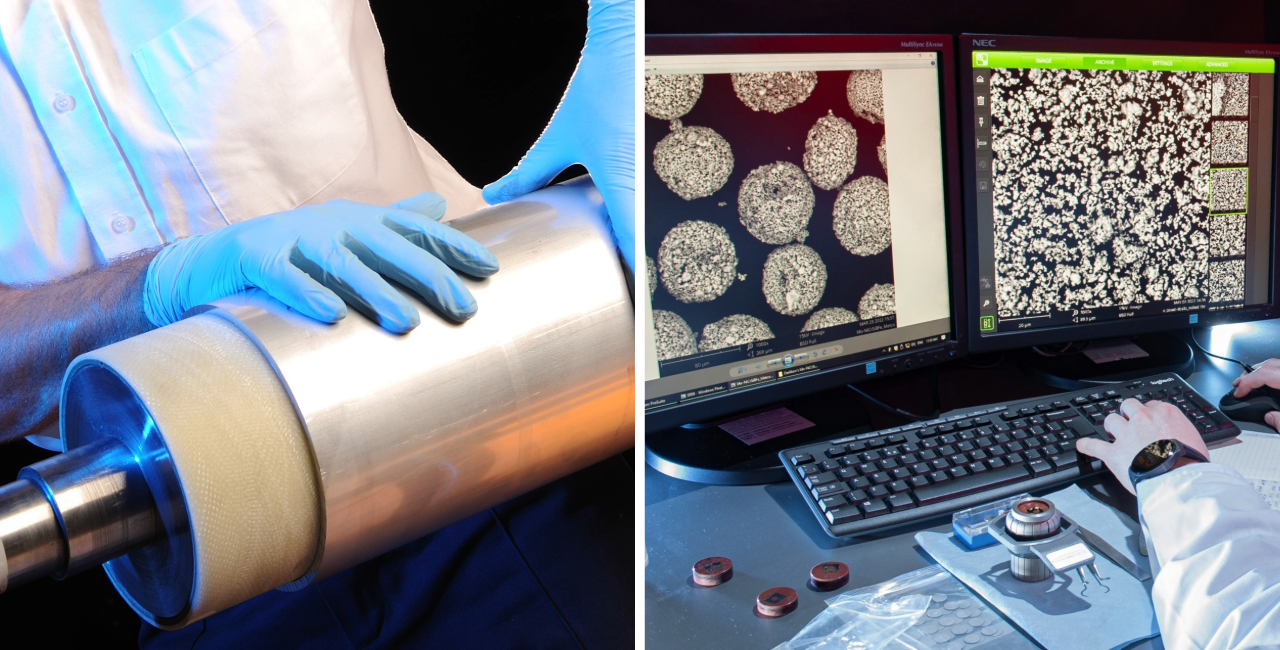
Our approach at Sandon Global is to engineer stability into the sleeve from the inside out. Our patented sleeve construction (Pat. EP3368317B1 and Pat. US11059284) pairs a solid aluminium tube with stainless steel threaded end rings to create a rigid, stable structure that performs reliably at high speed.
The solid aluminium tube, drawn in Germany, provides rigidity far beyond ribbed alternatives. Ribbed designs are more prone to deformation under load and internal layer separation, particularly during liquid chemical cleaning. A solid structure maintains its geometry, protects concentricity, and prevents the internal movement that leads to delamination.
At Sandon, we use high-quality fibreglass inners from XSYS and Rossini because of their strength and dimensional stability under heat and pressure. This supports the anilox sleeve architecture and helps it retain its roundness throughout repeated production cycles.
Our stainless steel end rings are produced in-house. Each ring is CNC-machined and threaded to lock precisely into the aluminium tube and sealed with a gasket system designed to prevent fluid ingress. This protection is vital for preventing corrosion, delamination and irregular TIR.
The strength and stability of this unique structure allow sleeves to be refurbished multiple times while maintaining geometry. This helps extend sleeve life, supports consistent TIR control and contributes to long-term ROI.
Materials science that safeguards engraving and ink release
Engineering alone cannot guarantee anilox performance. The ceramic coating must be consistent in hardness, porosity and microstructure to support accurate engraving and predictable ink release. If these properties drift, cell formation changes and ink transfer becomes inconsistent. Without monitoring porosity and hardness regularly, it is impossible for anilox suppliers to guarantee coating consistency. If coating consistency cannot be guaranteed, engraving consistency is compromised, affecting cell formation and ink release, which in turn impacts optical density.
This is where our in-house metallurgical laboratory plays a vital role, and why we have invested in the latest technologically advanced equipment. Every coated product is examined microscopically, tested for hardness and analysed for porosity. Our scanning electron microscope, with magnification up to 150,000x, allows us to assess micro-cracks, porosity distribution and surface topography with precision. Light microscopy and elemental analysis provide additional checks for durability, oxidation resistance and engraving consistency.
Before engraving, we also apply our unique Enhanced Densification Treatment. This proprietary process seals and densifies the ceramic, improving hardness, chemical resistance and surface uniformity. It provides a stable base for sharp and consistent cell structures, supporting reliable ink release and longer anilox life.
Our materials science capability has strengthened further with the arrival earlier this year of Dr Siddharth Lokachari, our Research and Technical Manager for the Plasma Coatings Division. His extensive background in advanced coating systems supports our programme of continuous improvement in anilox science.
Complete in-house control
Every anilox sleeve, roller, mandrel and end ring is manufactured at our headquarters in Runcorn, UK. Full vertical integration lets us control tolerances, seals, finishes and quality checks at every stage. This consistency supports stable colour reproduction and predictable print performance from one order to the next.
Durability, ROI and reduced waste
A stable sleeve construction protects concentricity and supports multiple refurbishments. This reduces the frequency of replacements, maintains geometry over a longer service life and lowers total cost of ownership. Longer life cycles also reduce waste and support more resource-efficient operations.
Many customers view our anilox as long-term production assets rather than consumables. With appropriate handling and routine care, Sandon Global anilox maintain consistent print performance for many years, a reputation that we have earned over two decades.
Meeting today’s flexo requirements
Modern flexo demands finer engravings, thinner ink films and precise control of ink transfer. Consistency requires engineered stability, reliable ceramic coatings and controlled manufacturing from start to finish.
This is why we continue to invest in both engineering and materials science. The stability of our anilox sleeve and end ring system, combined with our coating technology and strict quality controls at every stage, supports the consistency and reliability printers need in demanding production environments.
Reliable anilox performance reduces downtime, controls variation and gives printers confidence that each Sandon Global sleeve or roller will perform consistently, delivering a stronger return on investment over time.
About the author
Daniel Niehues is Regional Sales Manager – Europe, Sandon Global. He manages Sandon Global’s direct sales across Europe and the wider European sales and distribution network. Based at the company’s German office, Daniel joined the company in 2023. Daniel holds a degree in print and media technology from the University of Wuppertal. His earlier career includes positions with Flint Group in quality assurance and technical field service, followed by nearly six years with XSYS Global as Regional Sales Manager. His experience across the flexo supply chain supports his work with printers and converters across Europe.
To discover how Sandon Global can help YOU achieve flexo print excellence and a stronger return on investment, get in touch with our team today!
< Return to Blog Posts